Sie befinden sich in den Archiven der Kategorie Media.
| M | D | M | D | F | S | S |
|---|---|---|---|---|---|---|
| « Aug | ||||||
| 1 | 2 | 3 | 4 | 5 | ||
| 6 | 7 | 8 | 9 | 10 | 11 | 12 |
| 13 | 14 | 15 | 16 | 17 | 18 | 19 |
| 20 | 21 | 22 | 23 | 24 | 25 | 26 |
| 27 | 28 | 29 | 30 | |||
- Art (3)
- Asia (7)
- Beijing (300)
- China (202)
- Climbing (25)
- Cycling (140)
- Entrepreneur (5)
- Fixed Gear (203)
- France (7)
- Germany (33)
- Green (34)
- Hong Kong (3)
- Japan (12)
- Juggling (40)
- Malaysia (2)
- Media (53)
- Music (15)
- Natooke (57)
- Olympics (4)
- Outdoors (39)
- Performers (74)
- Thailand (4)
- Unicycle (6)
- USA (34)
- Wine (8)
- 19.8.2010: TV Documentary - Expo's Meaning, Shanghai's Mission
- 9.8.2010:
- 29.7.2010: Article: Peddling her Love of Bikes
- 28.7.2010: 2010 BEIJING FIXED GEAR REVOLUTION II - Aug 13-15 2010年8月13日至15日
- 20.7.2010: Alleycat Ralley in Erlangen
- 19.7.2010: Cycling and Juggling
- 19.7.2010: Germany Closes Highway for Cyclists and Pedestrians
- 10.7.2010: Magic Hospital Donations
- 9.7.2010: 3G Software Industry Event
- 9.7.2010: Tour de Beijing
- August 2010
- Juli 2010
- Juni 2010
- Mai 2010
- April 2010
- März 2010
- Februar 2010
- Januar 2010
- Dezember 2009
- November 2009
- Oktober 2009
- September 2009
- August 2009
- Juli 2009
- Juni 2009
- Mai 2009
- April 2009
- März 2009
- Februar 2009
- Januar 2009
- November 2008
- Oktober 2008
- September 2008
- August 2008
- Juli 2008
- Juni 2008
- Mai 2008
- April 2008
- März 2008
- Februar 2008
- Januar 2008
Archiv der Kategorie Media
Article: Peddling her Love of Bikes
29.7.2010 von Ines.
Today a nice article about my person was printed in the China Daily newspaper. The interview had been done a few days ago by William Axford. The online version of the China Daily article is here. The pictures I gave them were taken by the photographer Simon Lim. On the cover of the metro Beijing section of the newspaper it says: Peddling her Love of Bikes - German cyclist wants to share her two-wheeled passion.
Here is a copy of the online article:
Freewheeling acrobat peddles love of bikes
By William Axford (China Daily)
Updated: 2010-07-29 07:48
|
|
Merely peddling her bike from A to B isn’t enough for Ines Brunn.
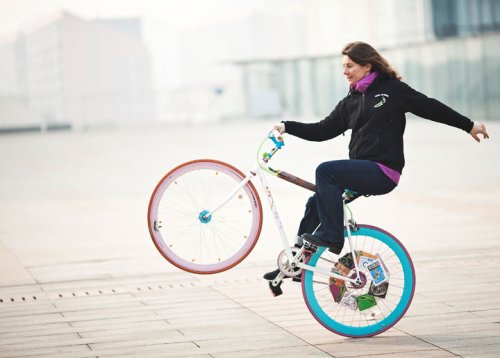
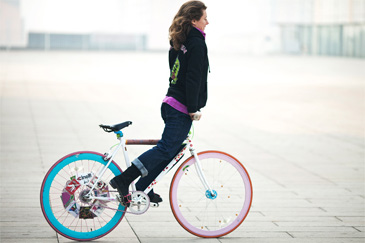
In addition to navigating her way through traffic, the German-born cyclist likes to perform gymnastic moves while zipping around on her bike.
She says for her, her bike is like a mobile balance beam. “I quit gymnastics when I was 13 because I wasn’t happy with the coach,” she said. “By chance, I came across trick biking and I’ve been doing it for 21 years.”
From performing a handstand on the seat to standing on the handlebars, the acrobat, who has impressed countless audience, has done things most people would think impossible on a moving bicycle.
With the fusion of her gymnastic talent, Brunn has even created new tricks and her rare skills have taken her all over the world.
“Once I cooked dumplings for a segment on CCTV while riding my bike. It took a lot of picking things up, putting them down, building up speed and then going back to cooking.”But such impressive feats come with a price.
Brunn says that an extensive amount of practice has to go into mastering the moves. A wrong mindset or the slightest mishap can be devastating.
“You have to be focused. During one performance in Beijing, I tried to tell people I needed space and taped off a circle. Someone didn’t listen and I crashed, chipping my tooth on my handlebars.”
She hasn’t let the experience ruin her passion.
“My tongue touches the chipped tooth every five minutes or so, reminding me to keep my cool.”
Brunn stretches herself and rides her bike constantly in order to practice her amazing feats. Even the weather can’t keep her from peddling around.
“I rode my bike from the Fifth Ring Road to the Second Ring Road in the rain for a meeting recently,” she said nonchalantly.
“My colleague was baffled but I didn’t mind. I love riding my bike.”
|
|
Brunn brought her enthusiasm for the fixed gear bike to Beijing by opening Natooke, China’s first fixed-gear bike and juggling shop. With the ability for customers to pick out every part of their bike and customize it to their liking.
Brunn predicts fixed-gear biking will become more popular in the coming years and she hopes that her shops and bike outings with other enthusiasts will rekindle an interest in bike riding.
“My friends and I just want to inspire others to ride bikes again,” she said.
“It’s so environmentally friendly and a real smart thing to ride.”
Q & A
Q: What makes fixed-gear bikes so special?
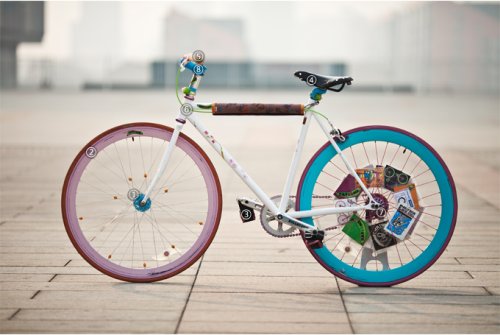
A: The back gear of the bike is fused to the wheel, so the bike is capable of pedaling forward and backward. The petals turn with the wheels. There’s no gearshifts or cables.
Q: Have you ever had an accident that made you think about quitting?
A: No. I think some things are addictive. People told me that I would quit after I got a job. If you have a passion for something, you’ll do it.
Q: What are some tricks that people commonly do?
A: One is called skidding, where you lean forward to stop the bike, causing the back wheel to come off the ground while riding. There are competitions to see who can skid the longest. There’s tricks too involving putting your legs over the handle bars, riding one handed and switching your feet on the pedals.
Q: Where do you get your parts for the bikes?
A: We order them from all over the world - America, Europe, Australia. Most of the parts have come from Taiwan but more are starting to be made on the Chinese mainland. I don’t like mass-produced bikes that are one color and just one style.
Geschrieben in Natooke, Media, Performers, Cycling, China, Fixed Gear, Beijing | 1 Kommentar »
Work that Pigu
11.6.2010 von Ines.
Today there was an article in the Global Times. They had interviewed Fede and Shannon while I was in Germany. The full article is here.
The title is “Work that Pigu”. Pigu mean ass. They had different sports sections, one of them being cycling. Here an excert of the original article:
Cycling
For those who prefer to pedal, the city is always open for biking. Bicycles are available in a variety of colors, styles, and price ranges on practically every street in Beijing. Cyclists have unlimited control over pacing and routes. And bike rides are free!
Federico Moro is the director of Natooke, a bike shop that specializes in fixed gear bikes and juggling. Moro praises Beijing as a city designed for bikes: completely flat, dry, and loaded with big bike lanes. He said of course there are individual health benefits for riding a bike, but, really, “everyone benefits: more bikes means less cars, less traffic.” And, of course, less traffic means less pollution for us all to breathe while we’re outside exercising.
Moro urges beginners to “get a bike and start to pedal. And get a helmet and a mask.”
Moro’s friend, Shannon Bufton, runs Smarter Than Car, a platform for promoting biking in the city. On the last Friday of every month, the group of about 50 riders hit the streets for a social ride set at a relaxing pace. Bufton agrees that biking is good for the environment, but also good for health. He said, simply, “It keeps you fit and keeps your weight down.”
Bikers looking for a challenge beyond the Dongzhimen interchange could head to the Laoshan Mountain Bike Course in west Beijing’s Shijingshan District. The 4.6 km Olympic course was made available to the public post-Games.
For serious mountain bikers, the thrill of riding in the paths of Olympians should outweigh the potential anxieties of getting a bike to west Beijing. And, for less serious cyclists, the trip to and from the course could be considered a full work-out in its own right.
Geschrieben in Media, Cycling, China, Beijing | Keine Kommentare »
Beijing TV Show about Fixed Gear Bikes
11.5.2010 von Ines.
Elaine came and continued to work on her nice road bike from the USA. Today the main issue for converting it was the bottom bracket. The cartridge style bottom bracket just did not want to fit inside. Elaine was already feeling a bit down at this point:

My cycling friend from Chile is preparing for his 20 day bicycle trip in South China. He came the store today to show me his bike (which he converted from fixed gear back to multispeed road bike) with the paniers for the trip.

And then we had the Beijing TV come, Guo Yan and a cameraman. This time it was 北京电视台生活节目: 生活面对面编导. They wanted to do a feature on fixed gear bikes, what they are about, why people ride them and how to ride.

So some of the Beijing fixed gear group came but had to wait for a while until Guo Yan finished interviewing me.

Then we rode to the Olympic village and the TV lady and cameraman drove there by car. We cyclists arrived so much earlier then them. By the time they came it was already dark and not so good for filming.


Then Guo Yan decided to try out my track bicycle with a huge crowd of Chinese watching.


After that we went for dinner back in the city.

And guess who also came to have food in the same restaurant: Cui Jian. The founder of rock music in China! He is the guy in white hiding on this picture.

Geschrieben in Media, Natooke, Fixed Gear, China, Beijing | 1 Kommentar »
Tianjin TV “China Right Here” Show Environmental Topic: Ines Brunn - the “Fairy on Wheels”
9.5.2010 von Ines.
The Tianjin TV documentary about my thoughts to a greener Beijing and blue sky that was broadcasted last year is now online. You can watch the full 30 minute film at this link: 单车天使 Fairy on the Wheels - Ines Brunn 伊泉. It shows my participation in the 2008 Greening the Beige event with my bicycle performance, how I cycle everywhere in all kinds of clothes, and how we started the Beijing fixed gear group. As well as my efforts to promote cycling for a better environment and blue Beijing sky.

一个德国女孩,一段绿色环保的旅程。伊泉,这位世界一流通信测试仪表公司驻亚太区的经理,已在北京骑行4年的她,无论是街头、巷尾,还是剧场、舞台。风驰电掣的身影,交错转动的车轮。这个人们眼中异样的女孩,脚踏着车轮,追逐着梦想—永恒绿色的主题。她和她的自行车就犹如一个符号,述说着新旧的故事,也承载着不断的希望。

Unrelated but interesting: Bobby Spokes made a comment on a South China Morning Post newspaper letter claiming that bikes are in the way of Porsche and Ferrari drivers in Hong Kong. He wrote: “You can throw a bit of science in. Cycling can take a quarter off a person’s perceived age and a third off the emotional and metabolic age. …”. I did not know that. And I could not find any scientific evidence yet. But that is probably why everybody thinks I am so young. You should cycle more too
I also found an article in China daily about cycling in Beijing.
Geschrieben in Green, Media, Performers, Cycling, China, Fixed Gear, Beijing | 1 Kommentar »
Beijing TV on Cycling being Green
5.5.2010 von Ines.
Wang Ying from Beijing TV came to my shop to interview me because she is the host for a show on environment and green topics. Of course in front of the rolling camera she said that she does not bike and would never want to cycle herself. The cameraman then stopped the camera and said she cannot say that so we re-did that part of the interview. Even though her job is to host this show on green topics but she was really offended when the cameraman proposed to buy her re-usable chopsticks because she said she is not such an environmental person. She does not care about green. But she is doing that program. She should change her job. I love TV.
Geschrieben in Media, Green, Cycling, China, Beijing | Keine Kommentare »
Global Times: Where’s the Catch
27.4.2010 von Ines.
Today there was an article about Fede and the juggling shop in the Global Times. It is a very nice article. Here is a copy:
Where’s the catch?
Source: Global Times April 27 2010

Goodness gracious… fire poi on the street in Beijing. Photos: Matthew Jukes
It looks good, works as a form of meditation, and can push your body beyond its natural boundaries. Although China may have been one of the first places it started, it has now been all but forgotten. But, there’s always room for change. “My idea is that juggling will have the same evolution as break dancing in Japan and Korea,” said Federico Moro, the man with the balls to keep the Beijing jugglers running.
Already a well loved hobby, and in some circles a professional sport in the West, juggling can be anything from the simple act of tossing a couple of lemons around to passing six sharp objects at speed across a stage. Quite simply put, it’s moving around a number of objects that exceeds the number of limbs you’re using to do it.
Here in Beijing it’s limited to a group of people who meet up on a Monday night. Strange fortune perhaps, as China was possibly one of the modern ancestors of juggling, albeit with swords.
Zen like
In the depths of Yugong Yishan, normally renown more for its music than strolling players, Moro, shouts out. “Anyone can do it!” and “It’s just like riding a bike!” This encouraging shout normally means a lot of sheepish grins as most of the novices in the crowd look down at the sea of dropped juggling balls around their feet.
“Everyone can do three balls. Everyone is able to do five balls; everyone can do six or seven balls,” explained Moro. “The whole point is the amount of time you are willing to put in.”
He insisted that all you need to learn how to juggle is two minutes of lesson, and then 10 to 20 hours of practice on your own. The more you’re spending scrabbling around on the floor to pick up dropped objects, the better. The idea is to keep swapping which hand you start throwing with, and to enter into the rhythmic zen like state which keeps three balls in motion just in front.
At any given meet up, the group can include newcomers, hardened pros and even the odd visitor just stopping by to keep in practice.
“I’ve been juggling for eight years,” said Koert Van Eijk who had come over to visit a member of his family in their place of work. “It’s my first time in Beijing, I thought I’d give it a shot and I found this group very close to the hotel,” he added. As an avid jongleur, he’d even brought his own balls. Van Eijk is used to the juggling clubs in Amsterdam, where visiting enthusiasts pop in for a quick practice.
Mind and body
Making it sound casual and easy is all very well after several years of practice, but it’s also good for the brain, as much so as meditation, and good for the body, in the same fashion as martial arts.
“Juggling is my meditation,” said Moro, who studies and connects mind and body movements as part of his project the Body Foundation. He’s now been juggling, and practicing the diabolo for around 10 years. “What I’m doing gives me the tools to do things in a different way. These tools are a good way to read yourself.”
The skill set may be similar to martial arts, with reflexes, dexterity and con-trolled movements which develop with practice. But there are fundamental differences, most importantly for Moro, the lack of “martial” in the arts.
“You don’t have to think about attack and defense,” said Moro, “and there’s no hierarchy involved.” He believes that both things detract from the body’s ability to learn, for jugglers you pick up the tool you want to practice with and work from there - no belts and sashes needed (unless you really want to).
The group in Beijing practice on the whole for fun and despite the obvious novelty as a party trick, and the fact circus skills help attract the opposite sex during festival season, China hasn’t branched into the pro circuit just yet.

Just like riding a bike. Photos: Matthew Jukes
Novelty
“At the first workshop I really loved it, but I never expected my legs would be so sore,” said Michelle Yu, a newcomer to the group who had been dashing about madly to pick up the balls. Like many hanging around the hall, she’d been brought by word of mouth to the workshop. “I really like it and want to practice and improve my skills; it’ll be a lot of fun when I don’t have to keep picking up the balls!”
Standing off to one side, so as not to injure anyone, the poi spinners also wander down to the Beijing jugglers, long term residents and visitors alike. For those who’ve never seen it, poi are a pair of wires with small weights on the end.
“It’s China! I just had to come and see this place!” exclaimed Ruben Valas, who’d been entertaining people, and more dangerously distracting motorists outside with some lit fire poi. He’d been traveling, but had met Dave Cooper, a member of the group in a bar and had come down. Cooper’s chosen tool is the devil stick, another Satanic sounding form of juggling done using balanced sticks.
“I picked up devil spinning at Glastonbury in 2004. Everyone can do three balls but no further. I just messed around a bit today devil sticking the festival away…” He was only too happy to put on an impromptu performance for a local travel channel that turned up to film the group last week.
The different forms of object manipulation practiced by the Beijing group all have their own unique style, and aesthetics, but the processes are essentially the same. You’ve got to be on your toes (hands) and stay focused to keep everything airborne.
“Of all the sports of we can imagine juggling is the one which improves the most connection of synapses in brain,” said Moro. “Switching between left and right, left and right, the two sides [of the brain] keep working at the same time.”
As a general rule the jugglers meet every Monday night in Yugong Yishan, travelers and passersby always seem to gravitate and share their experience and it’s normally an opportunity to see several different types of the art at the same time. If nothing else it gives the uncoordinated man on the street the opportunity to learn what they’re capable of and not get laughed at when their balls drop.
For more information check out www.natooke.com
Geschrieben in Natooke, Media, Performers, Juggling, China, Beijing | 1 Kommentar »
Article “Are There Really No Hipsters in China?” About Natooke in SLATE
21.4.2010 von Ines.
Wow, there was an article about fixed gear in China and about my bike shop in Slate online magazine. Here are some sections of the article:
Are There Really No Hipsters in China?
Irony-resisting Chinese bicyclists have skipped the fixed-gear trend that has swept the rest of the world.
By J. David Goodman
“BEIJING—A multicolored messenger bag slung over one shoulder and short-brimmed hat cocked to the side, Nie Zheng parked his brakeless bike in the corner of a trendy cafe in the Beijing Central Business District before settling into a molded plastic chair to chat about his particular obsession. “It’s been a dream since I was a kid to get a bicycle like this,” the 40-year-old fashion photographer told me. “But no one sold them here.” It took nearly nine months, he said, to get a track bike he wanted sent from England in 2007.
Such devotion is something of a rarity among the fashion-conscious in China, where bicycles are simply not mainstream cool. In fact, this bike-saturated nation has—so far—managed to skip entirely what is arguably the biggest global bicycle fad in a generation: the fixed-gear.
And the absence is notable. Despite the rise in car ownership, China remains the world’s largest bike market, with 51 million sold in 2009, according to the China Bicycle Association. With so many bikes, is it really possible that, apart from a few devotees like Zheng, no one in China got the trend memo? …”

“… Still, despite the odds, a handful of devotees from the West believe that now is the time to import the fixed-gear trend to China.
Hanging in the window of Ines Brunn’s new fixed-gear bike shop—Beijing’s first—is a Flying Pigeon that’s been converted into a fixie, a literal link between the past and what she believes will be the future.
“People ask: Why do you open a bike shop in Beijing? I think, well, you can do anything here,” said Brunn, a German-born physicist and acrobatic fixed-gear rider. In a year, her riding group has swelled from seven to 70. “I am optimistic!” she told a Beijing audience in November. “I see signs that the perception of the bicycle is changing.” …”
I cannot remember having made such a useless comment to why I opened the Natooke shop. I love bikes and bicycle culture. And I love riding fixed gear. In the past it was hard to get parts for fixed gear bicycles in China so by opening a shop I could enable more people to enjoy riding these bikes. And of course our fixed gear bike group in Beijing had grown now to over 150 people. Because fixed gear is more like a fashion trend it inspires the young generation to get on to bikes. I am happy to see that my shop also attracts the elderly Chinese bicycle lovers. There is still some remaining bicycle culture in Beijing and I am optimistic that it will not die out.
The article was written by J. David Goodman who writes about urban cycling for the New York Times. He writes about cycling and bike culture. It is really interesting. Thank you for this article ![]()
Geschrieben in Media, Fixed Gear, China, Beijing | 1 Kommentar »
Beijing Today News Article about STC
7.4.2010 von Ines.
Today we had a nice article in the Beijing Today newspaper. Here is the link to their online article.
Here is the copy of their article:
Cycling club says bikes solution to pollution, traffic jams
April 7, 2010

Smarter Than Car’s spring ride gathers 40 participants with fixed-gear bikes. Photo by Ines Brunn
By Annie Wei
In a country where every household has at least one bicycle, you would think nobody would bat an eyelash at another cycling club.
But a group-cycling event held last Sunday to welcome the arrival of spring still attracted local media like Beijing TV and the Global Times. The organizer, Smarter Than Cars (STC), is promoting bicycles as an alternative to cars as a chief mode of transportation around the capital. As a bonus, STC members are also taught bike stunts.
The club was founded by Shannon Bufton, an Australian urban designer, and Ines Brunn, a German trick cyclist and owner of Natooke, a bicycle shop. Bufton and Brunn said cycling is the best way to get around the city: it is cheap, will not get you snarled in traffic and is kind to the environment.
According to official data, 4 million cars were registered in Beijing at the end of last year, which meant increased air pollution and traffic jams. Meanwhile, the city’s main roads have bike lanes just waiting to be used.
On Sunday, 40 local and foreign STC members set off from the Drum and Bell Tower at 11 am and headed toward Chaoyang Park for a picnic lunch.
Brunn, a former member of Germany’s national artistic cycling team and who has been performing around the world for close to two decades, said she liked best the route along the Liangma Canal where cyclists can occupy almost the entire road.
The participants all rode fixed-gear bikes – models that are not capable of coasting since they have no freewheel; the sprocket is screwed directly onto the hub. Whenever the rear wheel turns, the pedals also turn in the same direction. A rider can slow or stop the bike by resisting the rotation of the pedals without needing to use the brakes. Pedaling backwards will also move the bike in that direction.
This type of bicycle is uncommon but is available at Natooke, located in Wudaoying Hutong, Dongcheng District.
After the ride, Bufton told reporters that STC is developing an iPod application that can help cyclists keep track of their distance, time and average speed. When ready, the software will be available at STC’s website, she said.
The club lines up one to two rides a month and welcomes new members. For more information about STC, visit natooke.com.
Geschrieben in Media, Cycling, Fixed Gear, China, Beijing | 1 Kommentar »
Global Times Article about STC Beijing
1.4.2010 von Ines.
Today there was another news article in the newspaper. This time it was in Global Times and about our STC ride that Shannon and I organized last Sunday. Here is the link to the original article on the Global Times website.
But I also copied the article so it can be read here directly.
Speeding pigeons
Source: Global Times [00:45 April 01 2010]

Ines Brunn, co-founder of Smarter Than Car, performs a bike trick show last Sunday. Photo: Wang Zi
STC (Smarter Than Car) is a Beijing based group which aims to promote cycling in the city as an enjoyable, healthy and sustainable activity and a much smarter alternative to driving a car or taking taxis.
It makes sense when Beijing’s car ownership exceeds four million. In STC co-founder Shannon Bufton’s words, we have more than enough reasons to go smarter and get more freedom to move around at least within the third ring road.
Congestion’s the first reason. Have you ever tried to get around on a Friday night or during the weekend and got stuck in the traffic? It is always stressful.
What STC has planned to do, as Bufton introduced, is to start to collect data by using GPS through an iPhone application on the average speeds of different transportation modes: bus, private car, taxi and bicycle, and publishing figures showing how much faster the bicycle is - and the time savings that can be achieved by switching back to the bike.
“That would involve our volunteers working for over a three-month period,” said Bufton. “We will also aim to discover the most used cycling routes and allow users to rate the safety and efficiency of the routes they have just taken.”
Cycling-friendly
Bufton, an Australian urban designer, has ridden in many different cities in the world and thinks Beijing’s one of the safest [to ride in the inner city]. Why? Because cars run more slowly. “And secondly, every person who drives a car in China has ridden a bicycle before so they sort of have more awareness of the bikers, like when and how they are going to turn left or stop,” he said.
Beijing is flat as a pancake, making it a fantastic place for urban cycling. The cycling infrastructure is still here according to Bufton. The bike lanes on some routes have been reduced but overall most roads have a bicycle lane.
There are not many other cities in the world that can boast this. Cities like Melbourne and London are bending over backwards and spending millions to improve infrastructure in their respective cities and they are still no where near to Beijing’s level of cycling lane infrastructure.
STC just formed in January and the followers rose from a few to about 50 people. The idea chimes easily with some of the local popular cycling clubs like Beijing Si Fei (Si means deadly; Fei means fly, aka Beijing Fixed Gear Club).
Breathing air
Ines Brunn, another co-founder of STC, former member of German national indoor cycling team, has been living in Beijing for five and a half years. She just opened a small fixed gear bike store in Wudaoying Hutong near the Lama Temple.
She admits that she commutes by bike and “goes everywhere by bike”. She’s not a cycling activist but helps the new-in-town “roadsters” like Michael Johnson, an American medical device company’s executive who just relocated from Malaysia to Beijing.
The night before the STC’s spring ride, Johnson received a call from Brunn telling him his new custom made fixed gear bike had arrived. “So here I am. I can’t believe that I am already in a community event even before I found a proper apartment. My other two bikes are still in the container and on the way to China,” Johnson said. He is may be too new to hear about the air conditions in Beijing.
Regarding the air that the cyclists breathe in, Bufton explained that actually staying in a closed car in a heavy traffic is even more dangerous because the car’s ventilation system keeps blowing in the fumes spewed by the car in front of you. To add double security, wear a cyclist’s mask.
STC has started to attach blinking lights to their bicycles so they are a moving “blinged up” bunch, also demonstrating to motorists they pass how much faster through the peak period of the week. Currently they are looking for a corporate sponsor to provide free lights to each rider.
Back on the Sunday spring ride: just before the group of 30 bikers of STC started off, Ines Brunn performed a short bike trick show upon request and within seconds pulled a larger crowd. A local pedicab guy, Lao Li, when told that these people are promoting using bikes to commute in city [instead of car], said: “Nice. Like us. It’s in China.”
Four tourists, young girls from England, happened to start their bicycle ride (recommended by a guide book) at Gulou plaza too and were amazed by Beijing’s community events involving both expats and local Chinese cyclists.
With their less smart-looking rental bikes parked by their side they said: “Of course. It’s a beautiful day to ride. But we want to have bikes like that,” pointing at the colorful wheels.
STC meet in front of the Drum Tower and ride to a different destination each time on the last Friday of each month at 7 pm. More details see STC’s website: www.stcbj.com.
shengtaotao@globaltimes.com.cn
Geschrieben in Media, Cycling, Fixed Gear, China, Beijing | 1 Kommentar »
Fixed Gear Article in Global Times
30.3.2010 von Ines.
While I was in Taiwan 2 weeks ago a writer from the Global Times newspaper came to interview Samantha and random customers that came to my bike shop. Today the article was published on the Global Times website. Here is a copy of their article:
Fixed-gear fixation
Source: Global Times
By Paul Morris
Cycling appears to be devolving. Remember when you were young and needed training wheels to stabilize your first bike? Styles have not gone that far back but they’re not far off. “They’re very cool now. All the hipsters back in Japan have fixed-gear bikes,” said Chinese fixed-gear enthusiast Liu Lin. “I often ride mine for 100 miles into the hills, but I’m in the minority. Most people hang out in cities trying and look cool.”
The fixed-gear – also referred to as fixed-wheel or single-speed – bike, unlike its geared counterparts, don’t allow the cyclist to freewheel or coast, i.e. you can only move forwards (or backwards) if you are peddling, as the sprocket is attached to the wheel’s hub. Although some still opt for them, this essentially alleviates the need for brakes; if you want to stop, you simply stop peddling.

I met Liu at Beijing (and China’s) only fixed-gear bike shop (which also doubles as juggling store), Natooke, in Wudaoying Hutong. German Ines Brunn opened the shop last year (though the official opening was early March this year). After over five years working for a telecommunications company in Beijing, she wanted to combine her knowledge of business with her true passion. “I had represented the German national team in artistic cycling and have been doing it for over 21 years,” she said. “It is hard work going through all the paperwork to open a business in China but we finally have our shop.”
After founding a club in 2007, Brunn quickly realized there was a demand not being met amongst Beijing’s cycling community. “People couldn’t get fixed-gear bikes or equipment in Beijing, even though they are made in China, so I saw an opportunity.”
A growth business
Business is slowly taking off. “We’ve sold around 20 bikes since we launched, but we knew it would take time to build interest,” said Samantha Song, general assistant at Natooke. “It is the same with many things, but as people in China get richer, they spend more on luxuries, like good bikes. And fixed-gear bikes are still a little too expensive for the average Chinese.”
Prices to purchase and assemble a complete bike range from 2,700 to 10,000 yuan, higher than the average standard bike in shops less than a stone’s throw from Natooke, though, as Brunn points out, no more expensive than a good quality road bike. And with the Beijing government’s new bike rental scheme (see page 9), it is difficult to see where fixed-gears will pick-up a market share.
So who is buying them in Beijing? The obvious answer is those who have money; it comes as no surprise that half of Natooke’s clients are foreigners. However, as with many subcultures, fixed-gear cycling is much more than simply riding a bike. “I saved for 6 months to get my first,” said Kan Jiaming, a math teacher at a local high school. “It’s not simply about the cycling, but all the things that come with it.”
Custom simplicity
Each bike at Natooke is custom-made in the shop, with the customer choosing the parts and the colors; Natooke also converts regular bikes to fixed-gears. The shop is decked with couches and cupboards with peddles, spokes and other cycling paraphernalia. It has the feel of your grandfather’s workshop-cum-coffee shop, and is obviously intended to be a place for the community, rather than the sole purpose of selling things. The parts are imported from Europe predominantly, where fixed-gear bikes are already popular with hipsters and bike messengers, but Natooke also designs and produces its own brand in China: the Flying Banana.
One of the attractions seems to be their simplicity and their reversion from bikes cluttered with gears, brake cables, cogs and reflectors. A fixed-gear bike need not be much more than two wheels, a frame and a chain. When Qing is asked how many people use them in Beijing, she replies “100,” matter-of-factly. She knows this because there is a club of sorts (with a Facebook site and everything) for Beijing’s fixed-gear bikers who like to get together once or twice a week and ride or practice tricks together. “The community will grow this year,” said Brunn. “Fixed-gear cycling is getting bigger and once the weather warms, I’d say we’ll have a over 150 members, which represents a big growth.”
The increasingly fashionable bikes are beginning to show signs of straying from the territory of enthusiasts to the realm of the layman, “They’re better for city riding than normal bikes, as you have much more control,” offered Andrew Cavanagh, the most recent of the 20 who have ever purchased from Natooke. “Beijing is a flat city, so you can move pretty quickly with more confidence about avoiding the city’s cab drivers.”
Cycle theft remains high and “if they want to take it, there is still nothing you can do,” said Liu. Yet the big challenge will be getting Beijingers to move from seeing cycling as a means of transport to something that can be savored and enjoyed. “Life needs to be about having fun, and that comes once you’ve got enough money to feed your family and you aren’t worrying about rent,” Liu said. “And there is nothing more fun than cycling.”
There was also another related article published regarding the Beijing government’s efforts to increase the number of cyclists. Read more here.
Geschrieben in Media, Cycling, Fixed Gear, China, Beijing | Keine Kommentare »